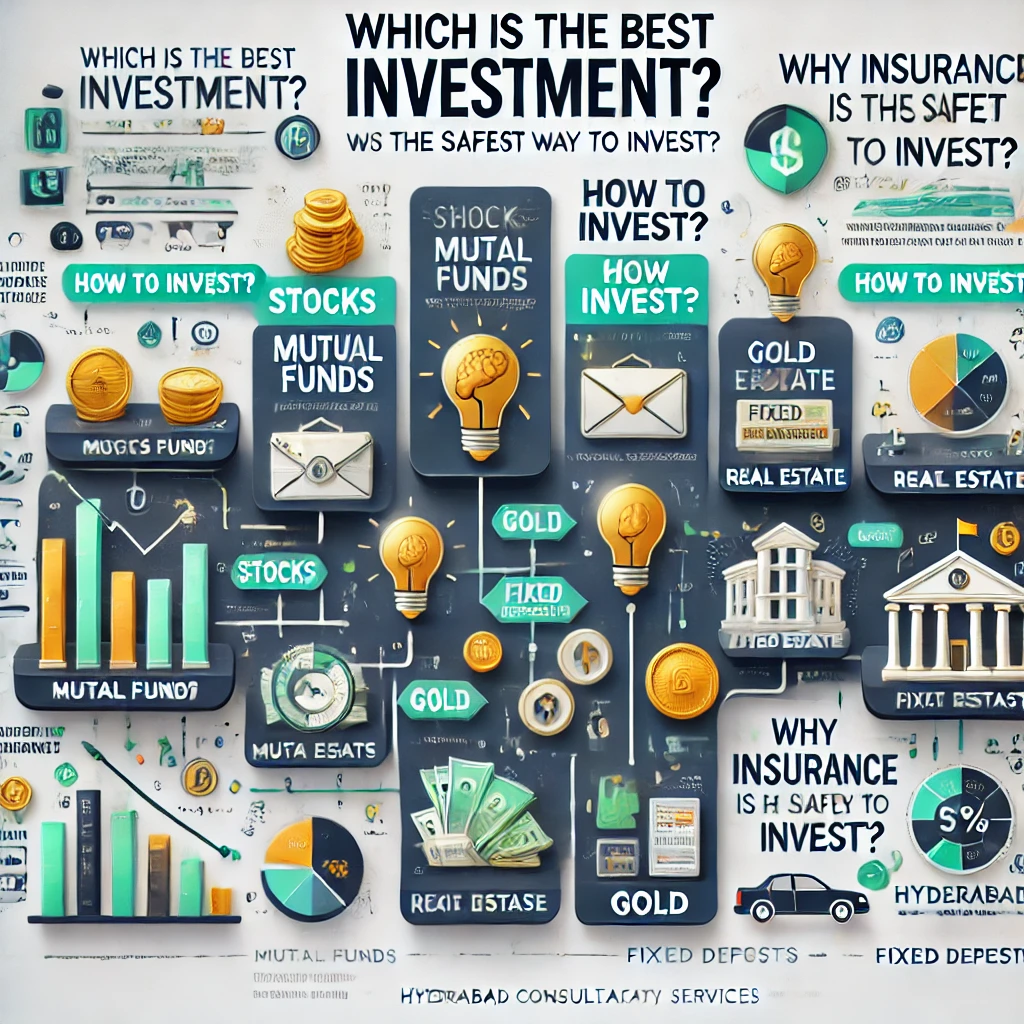
Insurance is considered one of the safest investment options because it provides both financial protection and guaranteed returns. Unlike other investments that depend on market fluctuations, insurance offers security and stability for individuals and families.

Which is the best Investment?

Which is the best Investment?

The best investment depends on your financial goals, risk tolerance, and time horizon. Here’s a guide to help you choose:

1. For High Returns (High Risk) 🚀

If you want higher profits and can handle risk:
Stocks (Equities) – Best for long-term growth (10+ years).
Cryptocurrency – High-risk but potential for huge gains.
Venture Capital & Startups – Investing in new businesses can be rewarding but risky.

2. For Stable & Medium Returns (Moderate Risk) 📈

If you want growth with some stability:
Mutual Funds & ETFs – Diversified investments with professional management.
Real Estate – Good for long-term appreciation and rental income.
Gold & Commodities – A hedge against inflation.

3. For Safe & Secure Investments (Low Risk) 🔒

If you want safety and steady returns:
Government Bonds & Fixed Deposits (FDs) – Low risk with guaranteed returns.
Savings Accounts & Treasury Bills – Best for liquidity and capital protection.
Dividend Stocks – Provides passive income with less volatility.

4. For Passive Income 💰

If you want regular earnings:
Rental Properties – Steady income from real estate.
Dividend Stocks & REITs – Earns regular payouts.
Bonds & Fixed Deposits – Predictable interest earnings.

Best Investment for You?

  • Young & Willing to Take Risks? 👉 Stocks, Crypto, Startups
  • Want Long-Term Wealth? 👉 Real Estate, ETFs, Gold
  • Need Security? 👉 Bonds, Fixed Deposits
  • Want Passive Income? 👉 Rental Properties, Dividends

How to Invest?

How to Start Investing? 💰📈

Investing is a great way to grow your wealth over time. Follow these simple steps to begin:


1️⃣ Set Your Investment Goals 🎯

Ask yourself:
Short-term goal (1-3 years) – Saving for a car, vacation, emergency fund.
Medium-term goal (3-7 years) – Buying a house, business expansion.
Long-term goal (7+ years) – Retirement, wealth creation, child’s education.


2️⃣ Assess Your Risk Tolerance ⚖

High-risk, high-return? → Stocks, Crypto, Startups.
Moderate risk? → Mutual Funds, Real Estate, Gold.
Low risk, steady returns? → Fixed Deposits, Bonds, Treasury Bills.


3️⃣ Choose an Investment Type 📊

Stock Market – Buy shares of companies for long-term growth.
Mutual Funds & ETFs – Diversified investments with professional management.
Real Estate – Rental income + property value appreciation.
Gold & Commodities – Safe investments during economic uncertainty.
Fixed Deposits & Bonds – Guaranteed returns with low risk.
Cryptocurrency – High-risk, high-reward potential.


4️⃣ Open an Investment Account 🏦

Stock Market: Open a Demat & Trading Account with a brokerage.
Mutual Funds & ETFs: Use an investment platform or mutual fund company.
Real Estate: Buy property through trusted agents or platforms.
Bonds & Fixed Deposits: Open accounts in banks or government portals.
Crypto: Use a crypto exchange (e.g., Binance, Coinbase, WazirX).


5️⃣ Start with a Small Investment & Diversify 🏗

Begin with a small amount and increase as you gain confidence.
Diversify investments to reduce risk (don’t put all money in one place).


6️⃣ Monitor & Adjust Regularly 🔍

✔ Keep track of market trends & company performance.
✔ Adjust your portfolio if needed (shift money from risky to safe investments).
✔ Stay updated with financial news.


7️⃣ Be Patient & Think Long-Term ⏳

✔ Investments grow over time, so don’t panic over short-term losses.
✔ Follow a disciplined investment plan for wealth creation.

Why Insurance is safest way to Investment?

Why Insurance is the Safest Way to Invest? 🔒💰

Insurance is considered one of the safest investment options because it provides both financial protection and guaranteed returns. Unlike other investments that depend on market fluctuations, insurance offers security and stability for individuals and families.


1️⃣ Dual Benefits: Protection + Investment 🛡💵

Insurance combines risk coverage (for emergencies) with savings or investment benefits.
Life Insurance – Protects your family in case of unexpected events.
Endowment & ULIPs – Offers investment returns along with life cover.
Health Insurance – Covers medical expenses, saving your wealth.


2️⃣ Low Risk, High Security 🔒

✔ Unlike stocks or crypto, insurance does not lose value due to market crashes.
✔ Provides a guaranteed payout in case of emergencies.
✔ Returns in savings-based insurance plans are fixed and secure.


3️⃣ Guaranteed Returns & Tax Benefits 📈💸

✔ Some insurance policies like endowment plans & ULIPs offer maturity benefits.
✔ Life insurance premiums are tax-deductible under Section 80C in many countries.
Death benefits are often tax-free for beneficiaries.


4️⃣ Best for Long-Term Financial Planning ⏳

✔ Helps in retirement planning with pension/annuity plans.
✔ Ensures your family’s future financial stability.
✔ Builds disciplined savings habits over time.


5️⃣ Peace of Mind & No Market Risks 😊

✔ Unlike stocks or real estate, insurance is not affected by market crashes.
✔ You don’t have to actively manage it—just pay premiums and stay covered.
✔ Ensures financial security for your loved ones, no matter what happens.


💡 Best Safe Investment Insurance Plans:

1️⃣ Term Life Insurance – Pure protection, best for financial security.
2️⃣ Endowment Plans – Combines savings + life cover.
3️⃣ ULIPs (Unit Linked Insurance Plans) – Offers market-linked returns.
4️⃣ Retirement Plans – Guaranteed pension for post-retirement life.
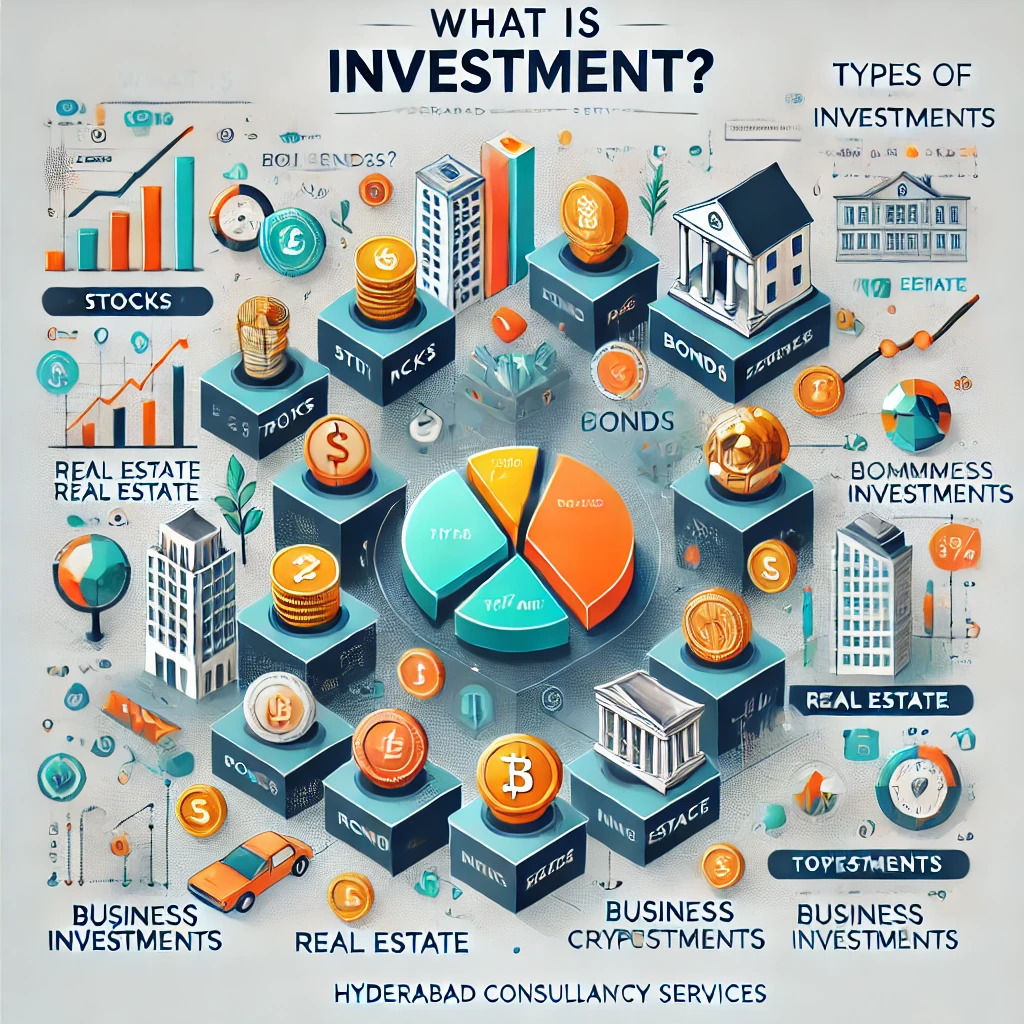

Investment is the act of allocating money, time, or resources into an asset, project, or venture with the expectation of generating a profit or gaining some benefit in the future.

What is Investment? and What are the types of Investments?

What is Investment?

Investment is the act of allocating money, time, or resources into an asset, project, or venture with the expectation of generating a profit or gaining some benefit in the future. Investments can be made in various forms, such as:

Types of Investments:

  1. Financial Investments:

    • Stocks – Buying shares of a company to earn dividends or sell at a higher price.
    • Bonds – Lending money to governments or corporations in exchange for periodic interest payments.
    • Mutual Funds – Pooling money with other investors to invest in diversified assets.
    • Exchange-Traded Funds (ETFs) – Similar to mutual funds but traded on stock exchanges.
  2. Real Estate Investments:

    • Buying properties to rent or sell at a higher price in the future.
  3. Business Investments:

    • Investing in a startup or existing business for potential profit.
  4. Commodities Investments:

    • Buying physical goods like gold, silver, oil, or agricultural products as assets.
  5. Cryptocurrency Investments:

    • Investing in digital currencies like Bitcoin, Ethereum, etc.
  6. Personal Investments:

    • Investing in education, skills, or self-improvement for future benefits.

Key Features of Investment:

Risk & Return – Higher returns usually come with higher risks.
Time Horizon – Investments can be short-term or long-term.
Liquidity – Some investments are easily converted to cash, while others take time.

What are the types of Investments?

There are several types of investments, categorized based on their nature and purpose. Here’s a breakdown of the major types:


1. Financial Investments 💰

These involve investing in financial instruments like stocks, bonds, and mutual funds.

🔹 Stocks (Equities) – Buying shares in a company to become a part-owner and earn profits through dividends or price appreciation.
🔹 Bonds (Fixed Income) – Lending money to governments or corporations in exchange for periodic interest payments.
🔹 Mutual Funds – Pooling money with other investors to invest in a diversified portfolio of stocks and bonds.
🔹 Exchange-Traded Funds (ETFs) – Similar to mutual funds but traded like stocks on exchanges.
🔹 Derivatives (Options & Futures) – Contracts based on underlying assets like stocks, commodities, or currencies.


2. Real Estate Investments 🏠

Investing in physical properties to earn rental income or capital appreciation.

🔹 Residential Properties – Houses, apartments, or rental properties.
🔹 Commercial Properties – Office buildings, retail spaces, or warehouses.
🔹 Real Estate Investment Trusts (REITs) – Investing in real estate indirectly through a company that owns and manages properties.


3. Commodity Investments 🌾🏭

Investing in physical goods that hold value over time.

🔹 Precious Metals – Gold, silver, platinum.
🔹 Energy Resources – Oil, natural gas, renewable energy.
🔹 Agricultural Products – Wheat, corn, coffee, etc.


4. Business & Entrepreneurial Investments 🚀

Investing in businesses for potential growth and profits.

🔹 Starting a Business – Building your own company.
🔹 Angel Investing – Providing capital to startups in exchange for equity.
🔹 Venture Capital – Investing in high-growth potential startups.


5. Alternative Investments 🎨💎

Non-traditional investments that can provide diversification.

🔹 Cryptocurrency – Digital assets like Bitcoin, Ethereum, etc.
🔹 Collectibles – Rare items like art, antiques, and rare coins.
🔹 Private Equity – Investing in private companies rather than public stocks.
🔹 Hedge Funds – Investment funds that use complex strategies for higher returns.


6. Personal & Human Capital Investments 🎓📚

Investing in yourself for future financial and personal growth.

🔹 Education & Skills Development – Courses, certifications, and training.
🔹 Health & Wellness – Investing in fitness and well-being for long-term benefits.


7. Fixed & Low-Risk Investments 🔒

For those looking for stable and secure returns.

🔹 Fixed Deposits (FDs) – Safe bank deposits with guaranteed interest.
🔹 Savings Accounts – Basic interest-earning accounts.
🔹 Government Bonds & Treasury Bills – Low-risk investments issued by governments.


Which Type of Investment is Best for You?

It depends on:
✔ Your risk tolerance (high-risk vs. low-risk).
✔ Your investment horizon (short-term vs. long-term).
✔ Your financial goals (wealth growth, passive income, security).

Why, When I talk about Insurance some of they were said No?

Why, When I talk about Insurance some of they were said No?

Why, When I talk about Insurance some of they were said No?

People say “No” to insurance for various reasons, often due to misconceptions, financial concerns, or a lack of awareness. Here are some common reasons why people refuse insurance:

1. Lack of Awareness & Understanding

  • Many people don’t understand how insurance works or why it’s essential.
  • They think it’s unnecessary because they feel they are healthy and nothing will happen to them.

2. Misconceptions About Insurance

  • Some believe that insurance is a waste of money if they don’t get any returns.
  • Others think insurers don’t pay claims easily, which makes them skeptical.

3. Financial Concerns

  • People may feel they cannot afford the premiums.
  • They prioritize other expenses over insurance, thinking it’s not urgent.

4. Procrastination (I’ll Buy It Later)

  • Many believe they can buy insurance later, not realizing that premiums increase with age and health conditions.

5. Trust Issues

  • Some have had bad experiences or heard negative stories about agents or companies.
  • Fear of being misled into buying a policy that doesn’t suit them.

6. “I Already Have Insurance”

  • Some have an employer-provided insurance plan but don’t realize it may not be enough.

7. Overwhelmed by Choices

  • Too many policy options confuse people, leading them to avoid the decision altogether.

How to Handle These Objections?

Educate them – Share real-life examples of how insurance has helped families.
Show them the risks – Explain what would happen if they don’t have coverage.
Break down the costs – Show how affordable it can be compared to their daily expenses.
Address their concerns – If they fear claims rejection, explain how claim settlements work.

What type of people are taken Insurance?

Insurance is taken by a wide range of people, depending on their needs and financial responsibilities. Here are the types of people who commonly take insurance:

1. Breadwinners & Salaried Individuals

  • People who support their family financially take insurance to ensure their loved ones are secure if something happens to them.

2. Parents (Especially with Young Children)

  • Parents buy insurance to secure their children’s future, including education and daily expenses, in case of unexpected events.

3. Homeowners & Loan Borrowers

  • Those with home loans, personal loans, or business loans take insurance to ensure their family is not burdened with repayments if they pass away.

4. Business Owners & Entrepreneurs

  • Business owners take insurance to protect their company from financial risks, cover liabilities, or secure key employees.

5. Self-Employed & Freelancers

  • Since they don’t have employer-provided benefits, they opt for insurance to ensure financial security for their families.

6. Young Professionals

  • Many young individuals buy insurance early because it’s cheaper at a young age, and they can lock in lower premiums for a longer duration.

7. Senior Citizens & Retirees

  • They may take health insurance or pension plans to cover medical expenses and ensure financial independence in old age.

8. High-Net-Worth Individuals (HNIs)

  • Wealthy individuals take large life insurance policies for estate planning and tax benefits.

9. People Planning for Tax Benefits

  • Many buy insurance to avail of tax deductions under Section 80C, 80D, and other tax-saving schemes.

10. Employers Providing Group Insurance

  • Companies offer group insurance policies to employees as part of their benefits package.
A Term Policy is useful for individuals who have financial dependents or liabilities. It provides financial protection to your family in case of your untimely demise.

What is a Term policy? and Is Term policy will useful?

Yes, a Term Policy is very useful, especially if you have financial dependents or liabilities.

What is a Term Policy?

A Term Policy (or Term Life Insurance) is a type of life insurance that provides coverage for a specific period, known as the term (e.g., 10, 20, or 30 years). If the policyholder passes away during this period, the beneficiaries receive a death benefit (a lump sum payout). However, if the policyholder survives the term, the policy typically expires with no payout.

Key Features of a Term Policy:

  1. Fixed Duration – Coverage lasts for a predetermined number of years.
  2. Affordable Premiums – Usually cheaper than permanent life insurance.
  3. No Cash Value – Unlike whole life or universal life insurance, it does not accumulate savings.
  4. Death Benefit Payout – Beneficiaries receive a lump sum if the insured dies during the term.

Types of Term Policies:

  • Level Term – Fixed premiums and death benefit for the entire term.
  • Decreasing Term – Death benefit reduces over time (often used for mortgage protection).
  • Renewable Term – Can be renewed after the term expires, often with higher premiums.
  • Convertible Term – Can be converted into a permanent life insurance policy.

Who will taken Term policy?

A Term Policy is ideal for individuals who want affordable life insurance coverage for a specific period. It is particularly beneficial for:

Who Should Take a Term Policy?

  1. Young Professionals & Breadwinners
    • If you have dependents (spouse, children, or parents) who rely on your income, a term policy ensures financial security for them in case of your untimely death.
  2. Parents with Young Children
    • A term policy can help cover education expenses, daily living costs, and other financial needs if something happens to you before your children become independent.
  3. Homeowners with Loans or Mortgages
    • If you have a home loan, personal loan, or other debts, a term policy ensures that your family is not burdened with these liabilities.
  4. Business Owners & Entrepreneurs
    • Business partners or key employees can take term insurance to secure financial stability in case of unexpected loss. It can also be used for loan repayment.
  5. Newly Married Individuals
    • If your spouse depends on your income, a term plan ensures they are financially secure in your absence.
  6. Self-Employed or Freelancers
    • Without employer-provided life insurance, self-employed individuals can benefit from a term policy for financial protection.
  7. Anyone Looking for High Coverage at a Low Cost
    • Since term policies are the most affordable type of life insurance, they are suitable for those who want maximum coverage at a low premium.

Is Term policy will useful?

Yes, a Term Policy is very useful, especially if you have financial dependents or liabilities. Here’s why:

Benefits of a Term Policy

Affordable Premiums – It provides high coverage at a low cost compared to other life insurance plans.
Financial Security for Family – Ensures your loved ones are financially stable if something happens to you.
Debt Protection – Helps clear loans (home loan, personal loan, car loan, etc.), preventing financial burden on your family.
Fixed Death Benefit – Your beneficiaries receive a lump sum payout if you pass away during the policy term.
Peace of Mind – Knowing your family’s future is secure gives you mental relief.
Tax Benefits – Premiums paid are eligible for tax deductions under Section 80C of the Income Tax Act (varies by country).

When is a Term Policy Most Useful?

✔ If you have dependents (spouse, children, or aging parents).
✔ If you have loans or financial liabilities that need repayment.
✔ If you are a sole earner in your family.
✔ If you want simple life coverage without investment components.

Whom Term policy is useful?

A Term Policy is useful for individuals who have financial dependents or liabilities. It provides financial protection to your family in case of your untimely demise.

Who Can Benefit from a Term Policy?

  1. Salaried Individuals & Breadwinners
    • If your family depends on your income, a term policy ensures they are financially secure if something happens to you.
  2. Parents (Especially with Young Children)
    • Helps secure your children’s future by covering education, daily expenses, and other financial needs.
  3. Home Loan Borrowers
    • Ensures that your family is not burdened with repaying your outstanding home loan, personal loan, or any other debts.
  4. Business Owners & Entrepreneurs
    • Can be used for key person insurance or to cover business liabilities and loans in case of an unforeseen event.
  5. Newly Married Individuals
    • Protects your spouse financially if you are the primary income earner.
  6. Self-Employed & Freelancers
    • Since they may not have employer-provided insurance, a term policy ensures financial security for their family.
  7. Young Professionals
    • Buying early means lower premiums and long-term financial protection.
  8. Anyone Looking for Affordable Life Coverage
    • If you want high life coverage at a low cost, term insurance is the best option.
People often realize the importance of insurance for securing their family when they experience or witness life-changing events.

Why some people doesn’t awareness of an Insurance?

Why some people doesn’t awareness of an insurance?

Some people lack awareness of insurance due to several key reasons:

1. Lack of Financial Education

  • Many people are not taught about insurance, savings, or financial planning in schools or at home.
  • They may not understand how insurance works or its benefits.

2. Misconceptions & Myths

  • Some believe insurance is unnecessary if they are healthy or young.
  • Others think it’s a scam or that claims are never paid.

3. Lack of Trust

  • Past negative experiences with agents or complicated claim processes make people skeptical.
  • Fear of hidden terms and conditions discourages them from considering insurance.

4. Financial Constraints

  • Many people prioritize daily expenses over long-term financial security.
  • They may see insurance premiums as an extra burden.

5. Cultural and Social Beliefs

  • Some believe that family, savings, or community support is enough in times of crisis.
  • Others may consider buying insurance as an invitation to bad luck.

6. Complex Policies & Confusing Terms

  • Insurance policies often have complex terms, making it difficult for the average person to understand.
  • Terms like “deductibles,” “premium,” and “sum assured” can be confusing.

7. Poor Marketing & Awareness Campaigns

  • Many insurance companies focus on urban areas, leaving rural populations uninformed.
  • Lack of outreach programs leads to limited knowledge about available insurance options.

How to Increase Awareness?

  • Financial education programs in schools, workplaces, and communities.
  • Simplified policies with easy-to-understand language.
  • Government initiatives to promote insurance in underserved areas.
  • Trusted consultants to guide people in choosing the right plans.

How those people get awareness of an insurance?

People can gain awareness about insurance through various sources, including education, media, and community outreach. Here’s how:

1. Financial Education & Literacy Programs

  • Schools and colleges should include basic financial education covering insurance concepts.
  • Workshops and seminars can be organized at workplaces to educate employees.

2. Government Initiatives

  • Governments can run awareness campaigns through public service advertisements.
  • Subsidized insurance schemes (like health and life insurance for low-income groups) encourage people to learn about coverage.

3. Digital & Social Media Awareness

  • YouTube, blogs, and social media platforms provide easy-to-understand content on insurance benefits.
  • Influencers and financial advisors can share real-life stories to highlight the importance of insurance.

4. Insurance Agents & Consultants

  • Trusted insurance advisors can educate people by explaining policies in simple terms.
  • Free consultation services can help people understand their needs without pressure.

5. Community Engagement & Awareness Camps

  • Banks, NGOs, and local authorities can organize insurance awareness camps in rural and urban areas.
  • Door-to-door campaigns can help reach those who don’t use digital platforms.

6. Real-Life Testimonials & Case Studies

  • Sharing real-life experiences of people who benefited from insurance can encourage others to consider it.
  • Newspapers and TV channels can feature success stories of families who were financially saved by insurance.

7. Simplified Policy Documents

  • Insurance companies should use easy-to-understand language instead of complex legal terms.
  • Visual aids like infographics and videos can make information more digestible.

8. Employer-Provided Insurance Education

  • Many companies offer insurance to employees but don’t explain its benefits.
  • Conducting training sessions can help employees make informed decisions.

When people realized importance of Insurance in for secure a Family?

People often realize the importance of insurance for securing their family when they experience or witness life-changing events. Here are some key moments when they understand its value:

1. After a Medical Emergency

  • A serious illness, accident, or hospitalization brings unexpected medical expenses.
  • When they struggle to pay bills or see others benefit from health insurance, they realize its importance.

2. Sudden Loss of a Family’s Breadwinner

  • The death of a primary earner leaves dependents struggling financially.
  • Seeing families with life insurance remain financially stable highlights its necessity.

3. Experiencing Natural Disasters or Accidents

  • Events like floods, earthquakes, or fires destroy homes and possessions.
  • Realizing that home insurance could have saved them from financial ruin.

4. Facing Job Loss or Disability

  • Losing a job or becoming permanently disabled affects a family’s financial stability.
  • People understand the importance of income protection and disability insurance.

5. Witnessing Others’ Financial Struggles

  • Seeing relatives or friends suffer due to a lack of insurance creates awareness.
  • Hearing stories of people who benefited from insurance inspires action.

6. Planning for Children’s Future

  • Parents realize the cost of education and marriage, leading them to consider life insurance and investment plans.

7. Preparing for Retirement

  • As people near retirement, they realize the need for financial security and pension plans.
  • Watching elderly individuals struggle without savings reinforces the importance of planning ahead.

8. Legal or Financial Obligations

  • Buying a home, car, or starting a business often requires insurance, making people understand its role in financial protection.

Why Wait for a Crisis?

The best time to get insured is before these situations occur. Insurance provides peace of mind and financial security for your loved ones.

Insurance plays a crucial role in securing the life of a family by providing financial protection against unforeseen risks.

What is an Insurance role in secure life of a Family?

What is an Insurance role in secure life of a Family?

Insurance plays a crucial role in securing the life of a family by providing financial protection against unforeseen risks. Here’s how:

1. Financial Security

  • In case of the policyholder’s death, life insurance ensures that the family receives a lump sum amount to cover expenses and maintain their standard of living.
  • Health insurance covers medical bills, reducing the financial burden during illnesses.

2. Income Replacement

  • If the main earner of the family passes away or becomes unable to work due to disability, insurance policies like term life insurance or disability insurance help replace lost income.

3. Debt Protection

  • Insurance can cover outstanding loans (home, car, personal) so that the family does not have to bear the financial burden after the policyholder’s demise.

4. Education & Future Planning

  • Life insurance payouts can help fund children’s education and other future needs.
  • Investment-linked insurance policies (e.g., ULIPs, endowment plans) allow families to grow wealth while ensuring protection.

5. Medical & Critical Illness Coverage

  • Health insurance and critical illness insurance help cover high hospital bills, ensuring that savings are not depleted during medical emergencies.

6. Retirement & Long-Term Security

  • Pension plans and annuity insurance provide financial stability in old age, reducing dependency on children.

7. Emergency Fund

  • Certain insurance policies provide liquidity through loans or withdrawals, acting as an emergency fund during tough times.

In summary, insurance acts as a financial shield, ensuring that a family remains stable even in the face of life’s uncertainties.

Would you need choosing the right type of insurance for your needs?

I can definitely help you choose the right type of insurance based on your needs! It depends on factors like your family structure, income, debts, and future goals.

A few questions to guide you:

  1. Are you the primary earner in your family?
  2. Do you have dependents (spouse, children, elderly parents)?
  3. Do you have any existing insurance policies?
  4. Do you have any outstanding loans (home, car, personal)?
  5. Are you looking for life insurance, health coverage, or investment-based insurance?
  6. What’s your budget for insurance premiums?

Mahashivratri

Mahashivratri

Mahashivratri is a Hindu festival dedicated to Lord Shiva. It is observed on the 14th night of the waning moon in the month of Phalguna (or Magha, depending on the calendar followed). In 2025, Mahashivratri will be celebrated on February 26.

Significance

Mahashivratri marks the divine union of Lord Shiva and Goddess Parvati. It is also believed to be the night when Shiva performed the Tandava, the cosmic dance of creation and destruction. Devotees observe this festival to seek blessings, spiritual awakening, and liberation from past sins.

How is it Celebrated?

  1. Fasting – Many devotees observe a strict fast, consuming only fruits, milk, and water. Some even observe a nirjala (without water) fast.
  2. Nightlong Vigil (Jagran) – Devotees stay awake all night, chanting “Om Namah Shivaya” and singing bhajans in Shiva temples.
  3. Abhishekam (Ritual Bathing) – The Shiva Linga is bathed with milk, honey, ghee, curd, and sacred water, often mixed with Bilva (Bael) leaves.
  4. Temple Visits & Offerings – People visit temples, offer flowers, fruits, and prayers to Shiva. Some major temples like Kashi Vishwanath, Somnath, and Kedarnath see grand celebrations.
  5. Meditation & Chanting – Many practice meditation and chant Shiva mantras, as it is believed to bring peace and divine blessings.

Mahashivratri is celebrated to honor Lord Shiva, one of the principal deities in Hinduism. It is a spiritually significant festival that symbolizes devotion, self-discipline, and inner awakening.

Reasons for Celebrating Mahashivratri

  1. Marriage of Shiva and Parvati

According to Hindu legends, Mahashivratri marks the divine wedding of Lord Shiva and Goddess Parvati. Devotees, especially married and unmarried women, pray for a blissful marriage and the blessings of Shiva and Parvati.

  1. The Night of Shiva’s Cosmic Dance (Tandava)

Some scriptures state that Mahashivratri is the night when Shiva performed the Tandava, the celestial dance of creation, preservation, and destruction.

  1. Shiva as the Ultimate Consciousness

It is believed that on this night, Lord Shiva manifested as the Lingodbhava (infinite pillar of light), symbolizing his supreme power beyond time and space.

  1. A Night of Spiritual Awakening

Mahashivratri is considered the most auspicious night for meditation and self-realization. Devotees stay awake (Jagran), chant “Om Namah Shivaya,” and seek liberation (moksha).

  1. Myth of the Poison (Samudra Manthan)

During the churning of the ocean (Samudra Manthan), a deadly poison called Halahala emerged. To save the world, Shiva consumed it and held it in his throat, turning it blue (Neelkanth). Mahashivratri is observed in gratitude for this divine act.

  1. Symbol of Overcoming Darkness & Evil

The festival teaches self-discipline, overcoming ignorance, and embracing divine consciousness, making it a time for deep reflection and devotion.

Planning for your family's security involves taking proactive steps in multiple areas—financial, physical, emotional, and digital security.

How to plan for my Family will secure?

Planning for your family’s security involves taking proactive steps in multiple areas—financial, physical, emotional, and digital security. Here’s a step-by-step guide to securing your family’s future:


1. Financial Security Plan

Create an Emergency Fund – Save at least 3-6 months’ worth of expenses.
Get Insurance – Health, life, home, and vehicle insurance for protection.
Plan for the Future – Invest in education, retirement, and estate planning.
Minimize Debt – Pay off loans and avoid unnecessary financial burdens.
Have a Will & Legal Documents – Ensure your assets are legally protected.


2. Physical & Home Security Plan

Secure Your Home – Install strong locks, alarms, cameras, and smoke detectors.
Teach Emergency Plans – Family members should know fire exits, emergency numbers, and first-aid basics.
Health & Safety Preparedness – Keep a first-aid kit, food supplies, and emergency contacts ready.


3. Emotional & Mental Security Plan

Build Strong Communication – Encourage open discussions and emotional support.
Spend Quality Time – Strengthen relationships through bonding activities.
Recognize Mental Health Needs – Provide support, and seek professional help if needed.
Avoid Toxic Environments – Keep your family away from harmful influences or relationships.


4. Digital Security Plan

Educate Family on Cyber Safety – Avoid scams, use strong passwords, and verify links.
Monitor Children’s Online Activity – Set parental controls and discuss online dangers.
Back Up Important Data – Use cloud storage or external drives for essential documents.
Secure Devices – Install antivirus software and update software regularly.


5. Emergency Preparedness Plan

Create an Emergency Contact List – Include family, doctors, and emergency services.
Have a Disaster Preparedness Kit – Food, water, flashlight, batteries, and medical supplies.
Plan Evacuation Routes – In case of fire, flood, or other emergencies.

Ensuring your family's security involves multiple aspects—physical, financial, emotional, and digital safety.

How to knows that Family is secure?

How to knows that Family is Secure?

Ensuring your family’s security involves multiple aspects—physical, financial, emotional, and digital safety. Here are some key indicators that your family is secure:

1. Physical Security

✔ Your home has proper locks, security systems, or surveillance (if needed).
✔ Everyone knows emergency contacts and escape routes.
✔ Children are educated on basic safety rules (e.g., avoiding strangers, road safety).

2. Financial Security

✔ You have savings or an emergency fund for unexpected situations.
✔ Family members have health and life insurance coverage.
✔ There is a financial plan for future needs (education, retirement, etc.).

3. Emotional and Mental Security

✔ Open communication exists, and family members feel safe expressing themselves.
✔ No one is experiencing abuse, neglect, or extreme stress.
✔ There is a strong support system among family members.

4. Digital Security

✔ Everyone follows safe online practices (strong passwords, avoiding scams).
✔ Children’s online activities are monitored appropriately.
✔ Sensitive information is protected and not shared recklessly.

5. Health and Well-being

✔ Regular medical check-ups and vaccinations are up to date.
✔ There is access to clean food, water, and a healthy living environment.
✔ Family members support each other’s well-being and mental health.

Are You a Person in a Real Family Structure?

Are You a Person in a Real Family Structure?

Are You a Person in a Real Family Structure?

Are You a Person in a Real Family Structure?

A family is more than just a group of people living together—it is a system of relationships, responsibilities, and emotional connections. To determine whether you are part of a real family structure, consider the following aspects:

1. Understanding Your Role in the Family

Every family member has a role, whether as a parent, child, sibling, or extended relative. Ask yourself:

  • What responsibilities do you have in the household?
  • Do you contribute to decision-making, emotional support, or daily tasks?
  • How do other family members perceive and rely on you?

If you actively participate in family activities and responsibilities, you are part of a real family structure.

2. Your Responsibilities & Contributions

A functional family structure operates based on shared responsibilities. Consider:

  • Parents typically provide financial support, guidance, and care.
  • Children focus on learning, personal growth, and family bonding.
  • Grandparents offer wisdom, traditions, and sometimes childcare.
  • Siblings support and help each other navigate life.

If you fulfill one or more of these roles and contribute to the well-being of the family, you are integrated into the structure.

3. Emotional & Social Connections

Family is not just about duties but also about emotional bonding. Ask yourself:

  • Do you share experiences, celebrations, and challenges with your family?
  • Do you feel a sense of belonging and mutual care?
  • Do you turn to your family for support in times of need?

If you have deep emotional ties and actively engage with family members, your connection is real.

4. Legal & Biological Considerations

While families are traditionally based on biological connections, modern families also include step-relatives, adoptive members, and close guardians. Regardless of biological ties, what matters is whether you are acknowledged as part of the household and involved in its dynamics.

Conclusion

If you take on responsibilities, share emotional bonds, and play a meaningful role in the household, you are undoubtedly part of a real family structure. Family is defined by love, support, and commitment, rather than just blood relations.